

/

Little Books of Justice and Peacebuilding
Little books with a big impact
New Releases
Click book image for details
Little Book Titles
Click book image for details
Big Book of Restorative Justice
Restorative Justice Philosophy
Restorative Justice Practices and Skills
Organizations and Program Development
Race and Racial Healing
Education (K-12)
Education (Colleges and Universities)
Teaching Restorative Justice
Trauma and Violence
Special Topics

Conflict Transformation and Peacebuilding
Little Book Descriptions
Big Book of Restorative Justice
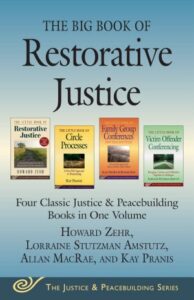
Big Book of Restorative Justice (2015)
Howard Zehr (Little Book of Restorative Justice)
Lorraine Stutzman Amstutz (Little Book of Victim Offender Conferencing)
Allan MacRae (Little Book of Family Group Conferences)
Kay Pranis (Little Book of Circle Processes)
Restorative justice, with its emphasis on identifying the justice needs of everyone involved in a crime, is a worldwide movement of growing influence that is helping victims and communities heal while holding criminals accountable for their actions. This is not a soft-on-crime, feel-good philosophy, but rather a concrete effort to bring justice and healing to everyone involved in a crime. Circle processes draw from the Native American tradition of gathering in a circle to solve problems as a community. Peacemaking circles are used in neighborhoods, in schools, in the workplace, and in social services to support victims of all kinds, resolve behavior problems, and create positive climates. Each book is written by a scholar at the forefront of these movements, making this important reading for classrooms, community leaders, and anyone involved with conflict resolution.
Restorative Justice Philosophy
Over 150,000-copies sold! Author Howard Zehr is the father of Restorative Justice and is known worldwide for his pioneering work in transforming our understanding of justice.
Here Zehr proposes workable principles and practices for making Restorative Justice possible in this revised and updated edition of his bestselling, seminal book on the movement.Restorative Justice, with its emphasis on identifying the justice needs of everyone involved in a crime, is a worldwide movement of growing influence that is helping victims and communities heal, while holding criminals accountable for their actions. This is not soft-on-crime, feel-good philosophy, but rather a concrete effort to bring justice and healing to everyone involved in a crime. In The Little Book of Restorative Justice, Zehr first explores how restorative justice is different from criminal justice. Then, before letting those appealing observations drift out of reach into theoretical space, Zehr presents Restorative Justice practices. Zehr undertakes a massive and complex subject and puts it in graspable from, without reducing or trivializing it.
Topics include:
- Three pillars of restorative justice
- The “who and the “how” are important
- The goals of restorative justice
- Core approaches often involve an encounter
- And much more!
This resource is also suitable for academic classes and workshops, for conferences and trainings, as well as for the layperson interested in understanding this innovative and influential movement.
Because of repeated requests from buyers and from those who work in this field, we are making this top-selling book available to Spanish readers.
- How should we as a society respond to wrongdoing?
- When a crime occurs or an injustice is done, what needs to happen?
- What does justice require?
- “Victims, offenders, and community members often feel that justice does not adequately meet their needs.
Justice professionals frequently express frustration as well. “Restorative justice is a process to involve, to the extent possible, those who have a stake in a specific offense and to collectively identify and address harms, needs, and obligations, in order to heal and put things as right as possible.
Restorative Justice Practices and Skills
Little Book of Restorative Justice and Community (2026)
Sheryl Wilson and Caitlin Morneau
This Little Book aims to expand upon the roles and responsibilities of community stakeholders in healing and repairative approaches to justice. Whether family members, friends, neighbors, concerned citizens, or system actors, the range of needs, obligations, and opportunities to engage with restorative justice processes is vast and deserving of greater attention. In this Little Book, Sheryl Wilson and Caitlin Morneau draw on experience in restorative justice facilitation, education, community organizing, and leadership in movement building to illuminate pathways that invite, expand, and sustain restorative justice engagement. The authors offer reflection, analysis, and considerations for community member support and inclusion in restorative justice processes and movement building.
This book is for the secondary victims of harm (witnesses or bystanders) who may not understand where they fit in the space of harm repair. This book is also for those in support of a person who caused harm and needs guidance on where they fit. Lastly, this book is for those in close proximity to harmful events and care about those who occupy the same space. As a community, there are ways people mobilize in organized groups when things go wrong, but what about when things are going right? How can we be good neighbors, co-workers, colleagues, and friends, so that when we do face challenges, we have a good starting place?
Little Book of Listening (2023)
Sharon Browning, Donna Duffey, Fred Magondu, John A. Moore, and Patricia Way
A practical guide to listening well in restorative justice programs and any relationship.
The Little Book of Listening is an introduction to and practical guide for listening as an emergent strategy for creating a transformed world. It presents radical listening as an essential macro-skill, one that is essential in forming “right relationships” with ourselves and others that are the necessary prerequisite to all lasting forms of social change.
This is a collaborative book, constructed from the contributions of twenty-six listeners from a wide variety of backgrounds who have shared their strategies, experiences, inspiration, and hopes for a transformed world through listening justly and equitably. One of the primary goals of the book is to offer practical tools for readers to develop the skills to listen to themselves and others more effectively, drawing attention to the barriers and filters that so often distract us from listening. Another goal is to inspire readers through the personal stories of how just listening has impacted the authors and invite readers to adopt these approaches themselves. Finally, we aim for this text to be a resource for practitioners in the fields of justicebuilding and peacebuilding.
Conversations are how humans explore new ideas and reach new understandings: paradigms shift and the world is changed by our communication with each other. Whatever processes are used, it is imperative that facilitators and participants listen deeply, humbly, and attentively, without ego or agenda, to themselves and to one another.
Little Book of Police Youth Dialogue (2021)
Dr. Micah E. Johnson and Jeffrey Weisberg
Discover the police-youth dialogue (PYD) as a method to build trustworthiness, mend relationships, and heal historical harms between black youth and law enforcement.
This timely book from the Justice and Peacebuilding series offers an explanation of the need for meaningful dialogue between law enforcement and black youth, a blueprint for implementing police-youth dialogues, best practices and examples, anecdotes and narratives from participants, different models and formats, potholes and limitations, and tangible tools and action steps for starting a police-youth dialogue program. Ultimately, the strategies and techniques used in effective police-youth dialogues can bring attention to issues of implicit bias and the impact of toxic stress on marginalized groups, ameliorate tensions between law enforcement officers and black youth, and build toward a model of community policing and restorative justice rather than punitive discipline and violence.
The Little Book of Police-Youth Dialogue presents readers with relevant knowledge and research regarding trauma and race in the United States, strategies for creating a safe space of attentive listening and mediating genuine connections between police officers and black youth, and specific ways to take action in ameliorating police-youth tensions and promoting healing in their local communities.
Victim offender dialogues have been developed as a way to hold offenders accountable to the person they have harmed and to give victims a voice about how to put things right. It is a way of acknowledging the importance of the relationship, of the connection which crime creates. Granted, the relationship is a negative one, but there is a relationship. Amstutz has been a practitioner and a teacher in the field for more than 20 years.
Circle processes offer a way of bringing people together to understand one another, strengthen bonds, and solve community problems—a necessity in an era of division, polarized politics, and angry debate.
Our ancestors gathered around a fire in a circle, families gather around their kitchen tables in circles, and now we are gathering in circles as communities to solve problems. This peacemaking practice draws on the ancient Native American tradition of a talking piece and combines that with concepts of democracy and inclusivity.
Peacemaking circles are used in neighborhoods to provide support for those harmed by crime and to decide sentences for those who commit crime, in schools to create positive classroom climates and resolve behavior problems, in the workplace to deal with conflict, and in social services to develop more organic support systems for people struggling to get their lives together. The circle process hinges on storytelling. It is an effort bringing astonishing results around the country. Chapters include:
- Circles in Practice
- A Circle Story—Finding a Way to Move Forward after a Workers Strike
- Foundations of Circles
- A Circle Story—Finding Understanding in the Classroom
- Key Elements of Circles
- A Circle Story—Finding Healing from Violent Crime
- Organizing a Talking Circle
- A Circle Story—Finding Respect Across Generations
- Circles in Perspective
- A Circle Story—Finding Connection within Family
Family Group Conferences (FGCs) are the primary forum in New Zealand for dealing with juvenile crime as well as child welfare issues. This third volume in The Little Books of Justice and Peacebuilding Series is about the juvenile justice system that is built around these conferences. Since their introduction in New Zealand, Family Group Conferences have been adopted and adapted in many places throughout the world. They have been applied in many arenas including child welfare, school discipline, and criminal justice, both juvenile and adult. In fact, FGCs have emerged as one of the most promising models of restorative justice. This Little Book describes the basics and rationale for this approach to juvenile justice, as well as how an FGC is conducted.
Organizations and Program Development
Little Book of Restorative Justice Program Design (2023)
Alisa Del Tufo and E. Quinn Gonell
A concise and practical guide to bringing the day-to-day practice of restorative justice programs into closer alignment with restorative values.
In the past twenty-five years there has been an explosion of programs, projects, and initiatives that use the terms “restorative justice” or “restorative practices.” This reflects multiple trends: the failures and inhumanity of justice system policies and practices; the unfairness and ineffectiveness of “zero tolerance” and other punitive measures adopted in our schools, and the positive impact of those who have promoted restorative practices for the past several decades around the world. This complex mix has generated an array of programs that utilize restorative ideas and practices in a wide variety of ways, such as court diversion, deeply spiritual circle work, and national and international truth and reconciliation projects. Some of these programs are designed to address incidences of harm that fall within large systems (family group conferencing, victim offender dialogue, circles, COSA, etc.) or in schools where they are often focused on addressing incidences of harm in an effort to change the over reliance on suspensions and expulsions as a way to modify student behaviors. There are other experiments in restorative justice that move this work into community settings, with a focus on healing and the creation of more empathic relationships.
As the authors know from experience, there is often a gap between values and the reality of day to day practice. This Little Book strives to find ways to shrink that gap and to bring our practice and the structures and methods that employ them into closer alignment with restorative values.
Simply put, this book asks, how can we better align restorative theory and practice in our work? In order to have truly restorative programs (programs that strive for consistency between their stated values and their real-life practices) the authors offer some ways to integrate restorative practices and values into the strategies used to design, implement, and assess them. They propose the use of another transformative practice, Participatory Action Research (PAR), as a powerful ally in the work of developing restorative practices and the programs that hold them.
Little Book of Healthy Organizations (2009)
David R. Brubaker and Ruth Hoover Zimmerman
The best way to change the world may be one organization at a time. With this ambitious claim, the authors of this highly readable primer provide insightful analysis for evaluating and improving the health of any organization. They advocate a “systems approach,” which views organizations as living systems, interconnected in their various departments, and interfacing with their environments. Leaders of organizations from all sectors will find sound advice concerning the four major components of organizations — their structure, leadership, culture, and environment.
Find out:
- What the classic dispute over “who gets the corner office” is really about.
- The difference between a good leader and a great one.
- What new hires may know about an organization that longer-term employees don’t.
- How organizational change and conflict are not only inevitable, but survivable.
Each chapter contains examples from the authors’ varied experiences with organizational change and conflict, written from a spirited, hopeful approach for creating a better world.
Race and Racial Healing
In our era of mass incarceration, gun violence, and Black Lives Matters, a handbook showing how racial justice and restorative justice can transform the African-American experience in America.
This timely work will inform scholars and practitioners on the subjects of pervasive racial inequity and the healing offered by restorative justice practices. Addressing the intersectionality of race and the US criminal justice system, social activist Fania E. Davis explores how restorative justice has the capacity to disrupt patterns of mass incarceration through effective, equitable, and transformative approaches. Eager to break the still-pervasive, centuries-long cycles of racial prejudice and trauma in America, Davis unites the racial justice and restorative justice movements, aspiring to increase awareness of deep-seated problems as well as positive action toward change.
Davis highlights real restorative justice initiatives that function from a racial justice perspective; these programs are utilized in schools, justice systems, and communities, intentionally seeking to ameliorate racial disparities and systemic inequities. Chapters include:
Chapter 1: The Journey to Racial Justice and Restorative Justice
Chapter 2: Ubuntu: The Indigenous Ethos of Restorative Justice
Chapter 3: Integrating Racial Justice and Restorative Justice
Chapter 4: Race, Restorative Justice, and Schools
Chapter 5: Restorative Justice and Transforming Mass Incarceration
Chapter 6: Toward a Racial Reckoning: Imagining a Truth Process for Police Violence
Chapter 7: A Way Forward
She looks at initiatives that strive to address the historical harms against African Americans throughout the nation. This newest addition the Justice and Peacebuilding series is a much needed and long overdue examination of the issue of race in America as well as a beacon of hope as we learn to work together to repair damage, change perspectives, and strive to do better.
This book introduces Coming to the Table’s approach to a continuously evolving set of purposeful theories, ideas, experiments, guidelines, and intentions, all dedicated to facilitating racial healing and transformation.
People of color, relative to white people, fall on the negative side of virtually all measurable social indicators. The “living wound” is seen in the significant disparities in average household wealth, unemployment and poverty rates, infant mortality rates, access to healthcare and life expectancy, education, housing, and treatment within, and by, the criminal justice system.
Coming to the Table (CTTT) was born in 2006 when two dozen descendants from both sides of the system of enslavement gathered together at Eastern Mennonite University (EMU), in collaboration with the Center for Justice & Peacebuilding (CJP). Stories were shared and friendships began. The participants began to envision a more connected and truthful world that would address the unresolved and persistent effects of the historic institution of slavery. This Little Book shares Coming to the Table’s vision for the United States—a vision of a just and truthful society that acknowledges and seeks to heal from the racial wounds of the past. Readers will learn practical skills for better listening; discover tips for building authentic, accountable relationships; and will find specific and varied ideas for taking action. The table of contents includes:
- Chapter 1: Introduction
- Chapter 2: Trauma Awareness and Resilience
- Chapter 3: Restorative Justice
- Chapter 4: Uncovering History
- Chapter 5: Making Connections
- Chapter 6: Circles, Touchstones, and Values
- Chapter 7: Working Toward Healing
- Chapter 8: Taking Action
- Chapter 9: Liberation and Transformation
And subject include Unresolved Trauma, Brown v. Board of Education, Lynching, Connecting with Your Own Story, Wht Healing Looks Like, Engage Your Community, and much more.
Education (K-12)
Little Book of Youth Engagement in Restorative Justice (2021)
Evelin Aquino, Heather Bligh Manchester, and Anita Wadhwa
The purpose of this book is to illuminate a theory of youth engagement in restorative justice that seeks to create systems change for more equitable schools. The authors define youth engagement in restorative justice as partnering with young people most impacted by structural injustice as changemakers in all aspects of restorative practices including community building, healing, and the transformation of institutions. Based on Adam Fletcher’s version of the Ladder of Youth Engagement, coupled with Barbara Love’s model of liberatory consciousness and an analysis of youth engagement in Restorative Justice in three different regions—Western Massachusetts, Oakland, and Houston—the authors provide a theoretical contribution: Youth Engagement in Restorative Justice grounded in liberatory consciousness.
In this book readers will find:
- Comparative case studies from different parts of the country of youth led restorative justice programs.
- An exploration of the cultural and historical context of each region to situate the work.
- Stories from the authors’ own lives that provide context for their interest in the work given their varied racial identities (White, Black, Latinx, South Asian) and upbringing.
- Literature review of the language of youth engagement vs. youth leadership/youth organizing/youth participation, along with a new definition of youth engagement in restorative justice.
- Theoretical framing based on Adam Fletcher’s Ladder of Youth Engagement , which provides a structure for the book.
- Exploration of how adults must combat adultism both individually and systematically as a prerequisite to doing this work.
- Student narratives.
- Applications of the work in the virtual context.
Little Book of Restorative Justice in Education (2022, 2nd edition)
Katherine Evans and Dorothy Vaandering
A fully revised & updated handbook for teachers and administrators on creating just and equitable learning environments for students; building and maintaining healthy relationships; healing harm and transforming conflict.
Much more than a response to harm, restorative justice nurtures relational, interconnected school cultures. The wisdom embedded within its principles and practices is being welcomed at a time when exclusionary discipline and zero tolerance policies are recognized as perpetuating student apathy, disproportionality, and the school-to-prison pipeline.
Relying on the wisdom of early proponents of restorative justice, the daily experiences of educators, and the authors’ extensive experience as classroom teachers and researchers, this Little Book guides the growth of restorative justice in education (RJE) into the future. Incorporating activities, stories, and examples throughout the book, three major interconnected and equally important aspects of restorative justice in education are explained and applied: creating just and equitable learning environments; building and maintaining healthy relationships; healing harm and transforming conflict. Chapters include:
- The Way We Do Things
- A Brief History of Restorative Justice in Education
- Beliefs and Values in Restorative Justice in Education
- Creating just and Equitable Learning Environments
- Nurturing Healthy relationships
- Repairing Harm and Transforming Conflict
- A Tale of Two Schools: Thoughts and Sustainability
The Little Book of Restorative Justice in Education is a reference that practitioners can turn to repeatedly for clarity and consistency as they implement restorative justice in educational settings.
Little Book of Restorative Discipline for Schools (2015)
Lorraine Stutzman Amstutz and Judy H. Mullet
How can teachers and administrators better deal with discipline, punishment, bullying, truancy, and other issues? Can community-building begin in a classroom?
The authors of this book believe that by applying restorative justice at school, we can build a healthier and more just society. With practical applications and models.
Can an overworked teacher possibly turn an unruly incident with students into an “opportunity for learning, growth, and community-building”? If restorative justice has been able to salvage lives within the world of criminal behavior, why shouldn’t its principles be applied in school classrooms and cafeterias? And if our children learn restorative practices early and daily, won’t we be building a healthier, more just society? Topics include:
- Why restorative justice
- The role of discipline and punishment
- Characteristics of peaceable schools
- Flexible policies
- Whole school training approaches
- Class meetings
- Truancy mediation
- Bullying
- And more!
Two educators answer yes, yes, and yes in this new addition to The Little Books of Justice and Peacebuilding series. Amstutz and Mullet offer applications and models. “Discipline that restores is a process to make things as right as possible.” This Little Book shows how to get there.
Education (Colleges and Universities)
Little Book of Restorative Justice for Campus Sexual Harms (2024)
Rachel Roth Sawatzky and Mikayla W-C McCray
A restorative justice approach to addressing sexual misconduct in colleges and universities.
Written for college and university practitioners and administrators, The Little Book of Restorative Justice for Campus Sexual Harms: A Holistic Approach to Address Sexual Misconduct and Relationship Violence for Colleges and Universities combines explanation, justification, and contextualization for the application of restorative justice (RJ) for sexual misconduct, including for alleged Title IX violations. This book outlines considerations, action steps, and best practices for campuses that are interested in exploring the successful implementation of RJ for sexual misconduct. The authors’ backgrounds as practitioners within the higher education context grounds this work with personal reflections, experiences, and stories.
This book provides a primer for colleges and universities who seek to move campus culture in a more restorative direction generally, and specifically for practitioners interested in exploring the possibility of amending existing sexual misconduct policies, including investigative-adjudicatory Title IX policy and procedures, through a restorative justice informed lens. Readers will explore why it makes all the difference (for both students and administrators) to add RJ resolution options.
Little Book of Restorative Justice for Colleges and Universities (2019, 2nd edition)
David R. Karp
A Practitioner’s Reference and Guide to Implement Restorative Justice on Campus
Here’s a call to colleges and universities to consider implementing restorative practices on their campuses, ensuring fair treatment of students and staff while minimizing institutional liability, protecting the campus community, and boosting morale, from an associate dean of student affairs who has put these models to work on his campus.
Restorative justice is a collaborative decision-making process that includes victims, offenders, and others who are seeking to hold offenders accountable by having them (a) accept and acknowledge responsibility for their offenses, (b) to the best of their ability, repair the harm they caused to victims and communities, and (c) work to reduce the risk of re-offense by building positive social ties to the community.
David Karp writes in his introduction, “As a student affairs administrator, I have become deeply committed to the concept and practice of restorative justice. I have experienced how it can work given the very real pressures among campus conduct administrators to manage high case loads, ensure fair treatment, minimize institutional liability, protect the campus community, boost morale in a division with high turnover, and help students learn from their mistakes without creating insurmountable obstacles to their future successes.”
Teaching Restorative Justice
Little Book of Restorative Justice Teaching Tools for Online Learning (2024)
Kathleen McGoey and Lindsey Pointer
Creating Restorative Learning Experiences Online
Teaching, training, and gathering online has become a global norm since 2020. Restorative practitioners have risen to the challenge to shift restorative justice processes, trainings, and classes to virtual platforms, a change that many worried would dilute the restorative experience. How can people build relationships with genuine empathy and trust when they are not in a shared physical space? How can an online platform become an environment for people to take risks and practice new skills without the interpersonal support available when meeting face to face? This book provides instructions for experiential games and activities that are intentionally designed for online learning spaces. It builds upon the core concepts of restorative pedagogy introduced in The Little Book of Restorative Teaching Tools (2020) to guide trainers and facilitators to overcome perceived limitations of virtual training and lean into the tools and possibilities that are unique to online spaces to create meaningful, engaging restorative learning environments.
This guide is a valuable resource for anyone seeking to build community and foster development of restorative justice knowledge and skills via online platforms. The games and activities included support building relationships, introducing the restorative justice philosophy, practicing key skills, and understanding and addressing structural and racial injustices. More resources are available at restorativeteachingtools.com.
Little Book of Restorative Justice Teaching Tools (2020)
Lindsey Pointer, Kathleen McGoey, and Haley Farrar
Engaging Practices for Integrating Restorative Justice Principles in Group Settings
As restorative practices spread around the world, scholars and practitioners have begun to ask very important questions: How should restorative practices be taught? What educational structures and methods are in alignment with restorative values and principles? This book introduces games as an effective and dynamic tool to teach restorative justice practices. Grounded in an understanding of restorative pedagogy and experiential learning strategies, the games included in this book provide a way for learners to experience and more deeply understand restorative practices while building relationships and improving skills. Chapters cover topics such as:
- Introduction to restorative pedagogy and experiential learning
- How a restorative learning community can be built and strengthened through the use of games and activities
- How to design games and activities for teaching restorative practices
- How to design, deliver, and debrief an activity-based learning experience
- In-depth instructions for games and activities for building relationships, understanding the restorative philosophy, and developing skills in practice
An ideal handbook for educators, restorative justice program directors and trainers, consultants, community group leaders, and anyone else whose work draws people together to resolve disagreements or address harm, this book will serve as a catalyst for greater creativity and philosophical alignment in the teaching of restorative practices across contexts.
Trauma and Violence
How do we address trauma, interrupt cycles of violence, and build resilience in a turbulent world of endless wars, nationalism, othering, climate crisis, racism, pandemics, and terrorism? This fully updated edition offers a practical framework, processes, and useful insights.
The traumas of our world go beyond individual or one-time events. They are collective, ongoing, and the legacy of historical injustices. How do we stay awake rather than numbing or responding violently? How do we cultivate individual and collective courage and resilience?
This Little Book provides a justice-and-conflict-informed community approach to addressing trauma in nonviolent, neurobiologically sound ways that interrupt cycles of violence and meet basic human needs for justice and security. In these pages, you’ll find the core framework and tools of the internationally acclaimed Strategies for Trauma Awareness and Resilience (STAR) program developed at Eastern Mennonite University’s Center for Justice and Peacebuilding in response to 9/11. A startlingly helpful approach.
Little Book of Restorative Justice for Sexual Abuse (2015)
Judah Oudshoorn wth Michelle Jackett and Stutzman Amstutz
Here is a thoughtful and thought-provoking look at the impact of sexual abuse demonstrating how restorative justice can create hope through trauma.
Restorative justice is gaining acceptance for addressing harm and crime. Interventions have been developed for a wide range of wrongdoing. This book considers the use of restorative justice in response to sexual abuse. Rather than a blueprint or detailing a specific set of programs, it is more about mapping possibilities. It allows people to carefully consider its use in responding to violent crimes such as sexual abuse.
Criminal justice approaches tend to sideline and re-traumatize victims, and punish offenders to the detriment of accountability. Alternatively, restorative justice centers on healing for victims, while holding offenders meaningfully accountable. Criminal justice responses tend to individualize the problem, and catch marginalized communities, such as ethnic minorities, within its net. Restorative justice recognizes that sexual abuse is a form of gender-based violence. The table of contents includes:
- Understanding Sexual Abuse
- Restorative Justice
- Victims: A Case Study
- Offenders: A Case Study
- Limits and Possibilities
- And much more!
Community-based practices are needed, sometimes in conjunction with, and sometimes to counteract, traditional criminal justice responses.
Special Topics
Little Book of Environment and Restorative Justice (2025)
Wanbli Wapháha Hokšíla, Nirson Medeiros da Silva Neto, João Salm, and Josineide Gadelha Pamplona Medeiros
A restorative approach to environmental justice.
This little book discusses paths to address environmental conflicts based on a restorative justice perspective of imagining, practicing, and living justice. It proposes an approach that understands the relationship between humankind and environment beyond the narrow conception of homo economicus, considering the human beings in their social, political, economic, historic, spiritual, cognitive, emotional, aesthetic, and ecological dimensions, as well as in their connection with nature and non-human entities.
When applied to environmental problematics, restorative justice needs to widen its perspective beyond an anthropocentric worldview, transcending the interpretation that human beings are the exclusively subjects of dignity, rights, needs, and speech capability. It is necessary to dilate horizons towards non-human entities and the natural spaces we inhabit and with whom we are deeply connected. This dilation should stimulate justice experiences that integrate building peace, sustainability, and good living, beyond ideas such as unlimited economic growth and even sustainable development. To this end, a restorative conception of justice implies an expanded understanding of justice that faces structural, cultural, institutional, and historical violence, as well as deals with intergenerational responsibility that integrate the present generations to those of the past in order to build the desired future for the generations to come.
Little Book of Restorative Justice for Older Adults (2017)
Julie Friesen and Wendy Meek
As our global population ages, conflicts and difficult conversations emerge. How will older adults decide who will make end-of-life health and financial decisions for them? When will dad need to move out of his home and into long-term care? We can’t have mom living with us anymore because it’s just too hard. Why are my children fighting over where I will live? Why is my son taking money from me? These are challenging scenarios that ever-increasing numbers of people are facing. Sometimes these difficulties are discussed in catastrophic terms:
- Untenable health-care costs
- Exhausted pension funds
- Crises in home-care and long-term housing
- And other concerns
Certainly, there are some reasons to worry; however, the challenges facing older adults can be an opportunity for positive change. The Little Book of Restorative Justice for Older Adults is about providing safe and respectful processes to assist in resolving conflict and addressing abuse involving older adults, families, caregivers, and communities. Authors Julie Friesen and Wendy Meek explore ideas to help connect and support people, building on the strengths and capacities of older adults and their families, in order to strengthen communities. Restorative justice dialogues help older adults and their families talk constructively and safely to find ways to move forward together.
Restorative justice argues that crime destroys people and relationships. Justice, then, must repair and rebuild people and relationships. This is true for men and women that are incarcerated as it is for victims.
The more than 2.3 million incarcerated individuals in the United States are often regarded as a throw-away population. While the criminal-justice system focuses on giving offenders “what they deserve,” it does little to restore the needs created by crime or to explore the factors that lead to it. Restorative justice, with its emphasis on identifying the justice needs of everyone involved in a crime, is helping to restore prisoners’ sense of humanity while holding them accountable for their actions.
In this book, Barb Toews, with years of experience in prison work, shows how people in prison can live restorative-justice principles. She shows how these practices can change prison culture and society. Chapters include;
- Crime and Criminal Justice
- Restorative Justice
- Reconnecting Community
- Reconnecting Individuals
- Reconnecting Victims and Their Communities of Care
- Reconnecting Offenders
- Reconnecting Offenders’ Families
- Restorative-Justice Practices
- Restorative Practices, Justice, and Prison
- Restorative Living in Prison
Written for readers who are incarcerated, and for all those who work with people in prison, this book also clearly outlines the experiences and needs of this under-represented and often overlooked part of our society.
Restorative justice pioneer Howard Zehr is also an accomplished photographer.
He begins his latest book with a confession—”I have written this book in part to encourage myself to slow down, to heighten my imagination, to renew myself while I gain a new view of the creation and the creator. With this book, Zehr makes a gift to anyone who would like to couple photography with seeing and thinking more deeply. In each chapter he offers a Purpose, a Problem, and an Activity with a camera in order to “practice mindfulness.” You’ll not need a fancy camera, but if you have one it won’t hurt. Zehr’s chapter-by-chapter exercises are aimed at heightening visual awareness and imagination—all while doing good and working for justice.
Chris Marshall writes, “the Bible has had a profound impact on the development of Western culture. So exploring biblical perspectives on justice can help us appreciate some of the convictions and values that have helped shape Western political and judicial thought.”
Christians also regard the Bible as a uniquely important source of guidance on matters of belief and practice. What the Bible has to say about justice, therefore—both social justice and criminal justice—ought to be of great significance for Christian thought and action today. Yet coming to grips with biblical teaching on justice is by no means easy. Chapters here include: what is justice; justice in the biblical worldview; contours of biblical justice; and Jesus and justice.
Upfront, Marshall addresses the many complexities that surround “justice” in the Bible: the Bible seems to hold conflicting points of view; there is a huge amount of data to deal with; the world of the Bible and our present world are vastly different. Marshall’s honest treatment of this subject is direct, yet almost lyrical in tone. He manages a thorny, multi-faceted subject clearly and ultimately singles out the broad areas of theological agreement among the Bible’s writers. Highly stimulating. Highly inspirational.
Conflict Transformation and Peacebuilding
Little Book of Transformative Community Conferencing (2016)
David Anderson Hooker
Will prove valuable and timely to mediators, restorative justice practitioners, community organizers, as well as leaders of peacebuilding and change efforts.
When conflicts become ingrained in communities, people lose hope. Dialogue is necessary but never sufficient, and often actions prove inadequate to produce substantial change. Even worse, chosen actions create more conflict because people have different lived experiences, priorities, and approaches to transformation. So what’s the story?
In The Little Book of Transformative Community Conferencing, David Anderson Hooker offers a hopeful, accessible approach to dialogue that:
- Integrates several practice approaches including restorative justice, peacebuilding, and arts
- Creates welcoming, non-divisive spaces for dialogue
- Names and maps complex conflicts, such as racial tensions, religious divisions, environmental issues, and community development as it narrates simple stories
- Builds relationships and foundations for trust needed to support long-term community transformation projects
- And results in the crafting of hopeful, future-oriented visions of community that can transform relationships, resource allocation, and structures in service of communities’ preferred narratives.
Hooker presents an important, stand-alone process, an excellent addition to the study and practice of strategic peacebuilding, restorative justice, conflict transformation, trauma healing, and community organizing.
This book recognizes the complexity of conflict, choosing long-term solutions over inadequate quick fixes. The Transformative Community Conferencing model emerges from the author’s thirty years of practice in contexts as diverse as South Sudan; Mississippi; Greensboro, North Carolina; Oakland, California; and Nassau, Bahamas.
Little Book of Dialogue for Difficult Subjects (2007)
LIsa Schirch and David Campt
Here is a process for talking about tension-filled topics. Useful for families, small groups, businesses, and private and governmental organizations, now, more than ever, because we are divided by political party, race, religion, and region, dialogue is an essential tool.
The word “dialogue” suffers from over-use, yet its practice is as transforming and as freshly hopeful as ever. Authors Schirch and Campt demonstrate dialogue’s life and possibilities in this clear and absorbing manual: “Dialogue allows people in conflict to listen to each other, affirm their common ground, and explore their differences in a safe environment.” Chapters include: Defending Dialogue, Organizing a Dialogue Process, Moving from Dialogue to Action, Assessing Dialogue Effectiveness and more.
Schirch has worked throughout the Southern hemisphere in peacebuilding projects. Campt has focused on racial and class reconciliation in American cities.
Some subjects seem too hot for a group to discuss sanely. Not necessarily. The Little Book of “Cool Tools for Hot Topics” — Group Tools to Facilitate Meetings When Things Are Hot shows how to help people hear each other when they feel like shouting; how to focus on the issues at stake rather than having a war of personalities; how to employ actual practices for better understanding (interviews, small-group discussions, role-reversal presentations); and how to move a group toward making a decision that all can honestly support. Lead author Ron Kraybill is a professor of Conflict Studies in the Conflict Transformation Program at Eastern Mennonite University, Harrisonburg, Virginia. During the years of the South African political transition, he trained local, regional, and national leadership in negotiation and mediation skills and served as a training advisor to the National Peace Accord. Cool Tools is rich in anecdotes and practical how-to for any group faced with tension-filled decision-making.
So we’d all like a more peaceful world—no wars, no poverty, no more racism, no community disputes, no office tensions, no marital skirmishes. Lisa Schirch sets forth paths to such realities. In fact, she points a way to more than the absence of conflict.
She foresees just peace—a sustainable state of affairs because it is a peace which insists on justice. Chapters include:
- Defining Strategic Peacebuilding
- Values for Peacebuilding
- An Overview of Peacebuilding Processes
- Waging Conflict Nonviolently
- Reducing Direct Violence
- Transforming Relationships
- And more!
Schirch singles out four critical actions that must be undertaken if peace is to take root at any level): ) waging conflict nonviolently, reducing direct violence, transforming relationships; and building capacity. From Schirch’s 15 years of experience as a peacebuilding consultant in Africa, Asia, and Latin America.
“This Little Book is an attempt to bring together the various fields and activities related to peacebuilding to integrate them into one conceptual framework. At the core of this framework is the idea of strategic peacebuilding, an interdisciplinary, coordinated approach to building a sustainable justpeace—a peace with justice. Strategic peacebuilding requires clear goals. While the concept of justpeace is growing in popularity, few writings lay out the vision and practice of justpeace. One aim of this book is to promote the concept of justpeace as an overall goal or vision for peacebuilding.
Most books on negotiation assume that the negotiators are in a stable settintg. But what about those far thornier times when negotiation needs to happen while other fundamental factors are in uproarious change— deciding which parent will have custody of their child while a divorce is underway; bargaining between workers and management during the course of a merger and downsizing; or establishing a new government as a civil war winds down. From Docherty’s experiences in environmental/public policy negotiations and community development work.
A guide to conflict resolution, or as the author prefers, “conflict transformation” that emphasizes the importance of building relationships and social structures through a radical respect for human rights and life.
This clearly articulated statement offers a hopeful and workable approach to conflict—that eternally beleaguering human situation. John Paul Lederach is internationally recognized for his breakthrough thinking and action related to conflict on all levels—person-to-person, factions within communities, warring nations. He explores why “conflict transformation” is more appropriate than “conflict resolution” or “management.” But he refuses to be drawn into impractical idealism. Topics include:
- Defining Conflict Transformation
- Conflict and Change
- Connecting Resolution and Transformation
- Creating a Map of Conflict
- Developing Our Capacities
- And much more!
Firmly rooted in faith and Mennonite teachings, and related to the popular concept of restorative justice, conflict transformation is an idea with a deep reach. Its practice, says Lederach, requires “both solutions and social change.” It asks not simply “How do we end something not desired?” but “How do we end something destructive and build something desired?” How do we deal with the immediate crisis, as well as the long-term situation? What disciplines make such thinking and practices possible?